waveform
Updated: Mar 16
How does a broken industrial part become an elegant candle holder?

It all began with a discarded object found on a street corner in lower Manhattan. I was attracted to the splash of red paint and its strange and sturdy form, so I picked it up and went on my way. I had no clue what it was.
It was only after looking up the patent number debossed in the inside of the wheel that I learned it was a metal ball caster wheel manufactured by Shepard.

I liked the heft of the metal and the aged, artistic look of the red spray paint on it. It needed to put it to use. Initially I thought maybe a drawer pull, a handle, or maybe a button of some sort, but that felt too obvious. I looked at different orientations and placements, and when I put it on its back and put a pencil in the little shaft I thought – oh? A candle holder?

Ok, a candle holder. But as it is, it was too dangerous as it moved too easily and the wax would drip everywhere. It needed something to keep it safely upright. I thought about embedding it into the table top of the associated nightstand, but that would compete with the already embedded bowl, so it had to be elevated.
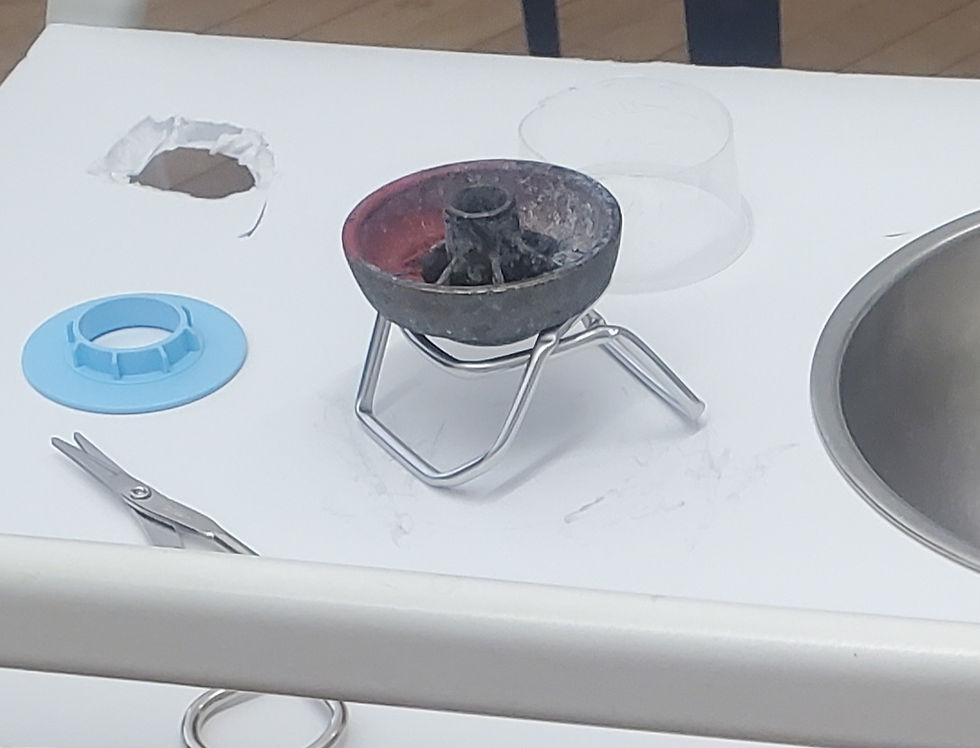
I experimented with different paper forms with different points and curves at different intervals. I arrived at the three-lobed waveform form as it was the sturdiest and most elegant of the forms I was looking at, and I appreciated that the gaps allowed view to the underside and creates a sense of floating.
I went on to refine the waveform, experimenting with different widths and heights. I measured the width of the wheel that touches the ground and based my measurements off of that, playing with wider and thinner waves, but arrived that a wave the same width as the wheel width looked the best, and I added just enough height to mirror the angles of the wheel and allow clear view of the bottom.


Now it is time to fabricate the actual object. I went with nickel silver to compliment the red paint and to contrast the aged bronze color of the caster wheel. I cut out three waves from sheet and filed the edges to a soft curve. I hammered each piece until they curved enough to meet at each corner. I soldered the three waves together and hammered them some more until the legs were at the right angle and the caster wheel fit nicely in its seat

I sanded the waveform with progressively finer grit and then polished to a soft polish – not too shiny as to compete with the caster wheel. Now it can hold the wheel to allow it to hold a candle and light the way to bed.

you can see photos of the final piece here.


Comments